What to See in Gernika
Picasso's Guernica is in Madrid, not Gernika. What the town actually holds: the assembly house, the oak, and the Peace Museum — and what 45 minutes covers.
Start with the correction, because a lot of people need it.
Picasso’s Guernica is not in Gernika. The painting hangs in Madrid, at the Museo Reina Sofía. Picasso made it in Paris in 1937 in response to the bombing, and it was first shown at the Spanish pavilion of that year’s Paris International Exposition. It has never been in the town whose name it carries.
Visitors do arrive expecting it. Better to know now.
What happened here
On 26 April 1937, during the Spanish Civil War, Gernika was bombed from the air by the Condor Legion of Nazi Germany and the Aviazione Legionaria of Fascist Italy, acting in support of Franco’s Nationalist forces. It was a market day.
The number of people killed is genuinely disputed. Published estimates run from around 150 to more than 1,600, depending on the source and the method, and the disagreement has itself been contested ground for decades. We are not going to give you a single figure with a confident air, because there is not one.
What is not disputed is what the attack was: the deliberate aerial bombardment of a town, and one of the first of its kind in Europe.
The Casa de Juntas and the oak
This is the reason Gernika mattered long before 1937, and it is the thing most day trips actually show you.
The Casa de Juntas — the assembly house — is the seat of one of the oldest parliamentary traditions in Europe. The General Assemblies of Bizkaia have met here, and the fueros, the charters setting out Bizkaian rights, were historically sworn beside it.
Beside it stands the Tree of Gernika, an oak that is the living symbol of Basque self-government. Successive trees have replaced one another over the centuries — it is the place and the continuity that carry the meaning, not any one trunk.
Standing in the assembly house is quiet and it is not a spectacle. It is, however, the part of the day people describe afterwards.
The Peace Museum
The Gernika Peace Museum was created by the town, and it does two things at once: it documents what happened on 26 April 1937, and it asks what a culture of peace would actually require. It is not a war museum with a moral tacked on.
Forty-five minutes will not do it justice, and the tour’s Gernika stop is forty-five guided minutes covering the town as a whole. If the museum is your reason for coming, that is an argument for visiting Gernika independently and giving it half a day. Gernika is reachable from Bilbao by train.
What 45 guided minutes does cover
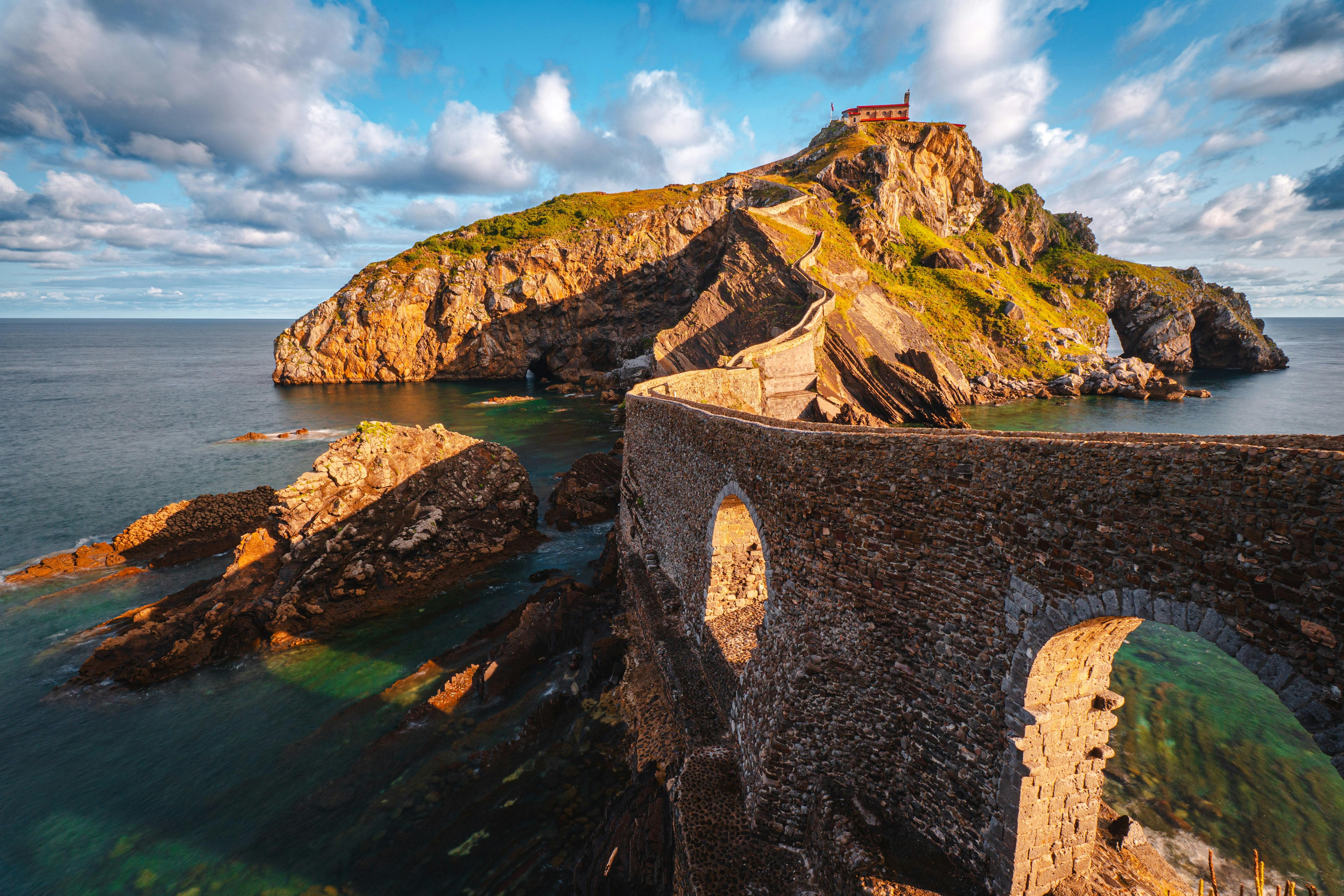
Realistically: the town centre, the Casa de Juntas and the oak, and enough context from a guide to understand why this small place is on the itinerary at all. That is a fair use of the time and it is more guided attention than Gaztelugatxe gets on the same trip.
Some of the alternative tours on this route give Gernika less, or give it as free time. In Gernika specifically that is a worse trade than it sounds, because the context is the substance — the buildings themselves are modest and much of the town was rebuilt.
Going in the right frame of mind
This stop sits between a rock hermitage and a fishing harbour on a day out, and that juxtaposition can feel odd. It is worth taking the twenty seconds to shift gear when the coach pulls in.
Gernika is a living town of ordinary people, not a memorial site. People work and shop there. The appropriate posture is the one you would bring to any place where something terrible happened and the community stayed: attentive, unhurried, and not treating it as a photo stop.
Book the Gaztelugatxe, Bermeo and Gernika Day
$70 from central Bilbao, with a guide at every stop and access tickets to San Juan de Gaztelugatxe included where required. Two hours at the headland, thirty guided minutes in Bermeo and forty-five in Gernika. Free cancellation up to 24 hours before.
Check Availability & Book